KESO: A Multi-JVM for Deeply Embedded Real-Time Systems
Overview
KESO is a Multi-JVM for embedded devices and networks of micro
controllers. KESO builds on a standard
OSEK/VDX
or
AUTOSAR OS
operating system that provides scheduling and synchronization mechanisms to
support multiple tasks on one micro controller. It furthermore provides
notification mechanisms and a timer concept that allows the handling of timed
or cyclic events.
KESO is designed for static embedded systems. The static nature of the system
enables the use of analyzing techniques that allow the creation of a system
that is highly adapted to the Java applications. Because complicated mechanisms
such as a dynamic loader for Java classes are not required in such a system, we
can achieve code sizes that allow to run KESO on smallest embedded devices. To
avoid the interpretation of bytecode on the target controllers, the Java bytecode
is compiled to a native code binary image ahead of time.
KESO applications are developed in Java using a uniform programming model. Memory-safety
defects caused by out-of-bounds indexing, null-pointer dereferencing etc. are constructively
avoided by the type-safe programming language and the KESO runtime system. There
is a single configuration for the system as a whole. Subsequent configurations
such as the configuration for the OSEK/VDX operating system are created automatically
by jino , KESO's static analyzer and building tool. jino adopts concepts from abstract interpretation .
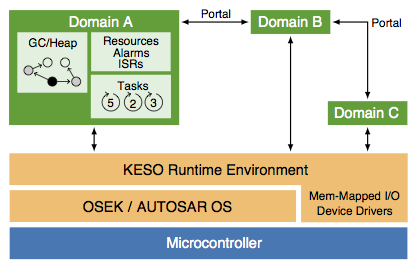
KESO provides a concept similar to the process concept found in modern operating
systems for personal computers. These units are called domains in KESO
and allow the safe co-existence of multiple tasks on the same micro controller.
These domains can communicate through a uniform portal mechanism that works
similar to Java Remote Method Invocation (RMI) or
Remote Procedure Calls (RPC) . The conceptual design of KESO was inspired
by the Java operating system for personal computers
JX .
KESO allows for software-based replication of selected (critical) applications.
Replicas are spatially and temporally isolated from each other and co-located applications by
domains. An application-specific majority voter picks a sane replica or triggers
the state recovery of a malfunctioning component. The feature is fully automated
and just needs to be activated in the system configuration.
KESO has experimental support for controller networks, which allow domains to
be located on different nodes while providing a global view to the application.
These domains will be able to communicate via the portal mechanism just as
domains that are colocated on a micro controller. Since the location of a
domain is transparent to the application, a relocation or integration of tasks
within the controller network will boil down to a reconfiguration that does not
require a change to the applications. KESO backends are currently available and
ready to use for the following platforms:
JOSEK ,
CiAO ,
Trampoline OS ,
Elektrobit ProOSEK (for TriCore) and
RTA-OSEK (for TriCore, untested).
Within the context of the
ARAMiS II project, KESO features such as assisted memory protection and the memory
handling from KESO's cooperative memory-management (CMM) framework are currently being implemented in the Astrée
static analyzer in cooperation with AbsInt Angewandte Informatik GmbH and the
German Aerospace Center (Deutsches Zentrum für Luft- und Raumfahrt (DLR)) .
KESO is unique in several aspects:
It is the first Multi-JVM for deeply embedded systems.
It provides OSEK/VDX API calls and system primitives to the (Java)
application developer, including service protection which is not provided by
OSEK/VDX operating systems.
It enables hardware drivers to be written in pure Java.
It can detect addressing errors caused by transient hardware faults (i.e., bit flips) without specific hardware support.
It provides per domain configurable heap management strategies (garbage collector (GC)): A throughput-optimized,
an incremental latency-aware and a fragmentation-tolerant real-time GC variant can be selected during system configuration.
Due to comprehensive static analyses, jino generates KESO applications whose resource requirements are
comparable to that of applications written in C. Developers of resource-constraint embedded systems can benefit
from the use of a modern high-level language and memory protection without the need for dedicated protection hardware.
Press: EETimes Article
License / Download
KESO is distributed under the terms of the GNU Lesser General Public License, version 3.
KESO is available as a snapshot
(2012-06-13).
The Documentation area contains various information that should help you
getting started with KESO.
Team
Michael Strotz M. Sc.
Christian Metz
Simon Schuster
Harald Bauer
Magnus Rauer
Philipp Sommer
Tobias Engelhard
Philip Taffner
Christian Bay
Martin Hofmann
Simon Kuhnle
2017
Schuster, Simon ; Ulbrich, Peter ; Stilkerich, Isabella ; Dietrich, Christian ; Schröder-Preikschat, Wolfgang : Demystifying Soft-Error Mitigation by Control-Flow Checking - A New Perspective on its Effectiveness 10.1145/3126503 ] (BibTeX )
Stilkerich, Isabella ; Lang, Clemens ; Erhardt, Christoph ; Bay, Christian ; Stilkerich, Michael : The Perfect Getaway: Using Escape Analysis in Embedded Real-Time Systems BibTeX )
2016
2015
Stilkerich, Isabella ; Lang, Clemens ; Erhardt, Christoph ; Stilkerich, Michael : A Practical Getaway: Applications of Escape Analysis in Embedded Real-Time Systems BibTeX )
2014
Stilkerich, Isabella ; Strotz, Michael ; Erhardt, Christoph ; Stilkerich, Michael : RT-LAGC: Fragmentation-Tolerant Real-Time Memory Management Revisited BibTeX )
Stilkerich, Isabella ; Taffner, Philip ; Erhardt, Christoph ; Dietrich, Christian ; Wawersich, Christian ; Stilkerich, Michael : Team Up: Cooperative Memory Management in Embedded Systems 10.1145/2656106.2656129 ] (BibTeX )
Erhardt, Christoph ; Kuhnle, Simon ; Stilkerich, Isabella ; Schröder-Preikschat, Wolfgang : The final Frontier: Coping With Immutable Data in a JVM for Embedded Real-Time Systems BibTeX )
2013
Stilkerich, Isabella ; Strotz, Michael ; Erhardt, Christoph ; Hoffmann, Martin ; Lohmann, Daniel ; Scheler, Fabian ; Schröder-Preikschat, Wolfgang : A JVM for Soft-Error-Prone Embedded Systems 10.1145/2465554.2465571 ] (BibTeX )
2012
Stilkerich, Isabella ; Sechser, Bernhard: Fehlertoleranz-Techniken automatisiert einbetten BibTeX )
Stilkerich, Michael : Memory Protection at Option - Application-Tailored Memory Safety in Safety-Critical Embedded Systems BibTeX )
Stilkerich, Michael ; Stilkerich, Isabella ; Wawersich, Christian ; Schröder-Preikschat, Wolfgang : Tailor-made JVMs for statically configured embedded systems 10.1002/cpe.1755 ] (BibTeX )
2011
Stilkerich, Isabella ; Stilkerich, Michael ; Kapitza, Rüdiger ; Lohmann, Daniel ; Schröder-Preikschat, Wolfgang : Automated Application of Fault Tolerance Mechanisms in a Component-Based System 10.1145/2043910.2043925 ] (BibTeX )
Stilkerich, Michael ; Schedel, Jens ; Ulbrich, Peter ; Schröder-Preikschat, Wolfgang ; Lohmann, Daniel : Escaping the Bonds of the Legacy: Step-Wise Migration to a Type-Safe Language in Safety-Critical Embedded Systems 10.1109/ISORC.2011.29 ] (BibTeX )
Erhardt, Christoph ; Stilkerich, Michael ; Lohmann, Daniel ; Schröder-Preikschat, Wolfgang : Exploiting Static Application Knowledge in a Java Compiler for Embedded Systems: A Case Study 10.1145/2043910.2043927 ] (BibTeX )
Wawersich, Christian ; Stilkerich, Isabella ; Stilkerich, Michael : The Use of Java in the Context of AUTOSAR 4.0 BibTeX )
2010
Stilkerich, Michael ; Lohmann, Daniel ; Schröder-Preikschat, Wolfgang : Gradual Software-Based Memory Protection BibTeX )
Stilkerich, Isabella ; Stilkerich, Michael ; Wawersich, Christian ; Schröder-Preikschat, Wolfgang : KESO: An Open-Source Multi-JVM for Deeply Embedded Systems 10.1145/1850771.1850788 ] (BibTeX )
Stilkerich, Michael ; Lohmann, Daniel ; Schröder-Preikschat, Wolfgang : Memory Protection at Option 10.1145/1772643.1772649 ] (BibTeX )
2009
2007
Wawersich, Christian ; Stilkerich, Michael ; Schröder-Preikschat, Wolfgang : An OSEK/VDX-based Multi-JVM for Automotive Appliances 10.1007/978-0-387-72258-0_8 ] (BibTeX )
Wawersich, Christian ; Stilkerich, Michael : KESO: A Type-Safe Middleware for Embedded Systems BibTeX )
2006
Wawersich, Christian ; Stilkerich, Michael ; Ellner, Ralf ; Schröder-Preikschat, Wolfgang : A Distributed Middleware for Automotive Applications BibTeX )
Stilkerich, Michael ; Wawersich, Christian ; Schröder-Preikschat, Wolfgang ; Gal, Andreas ; Franz, Michael: An OSEK/VDX API for Java 10.1145/1215995.1215999 ] (BibTeX )
(automatically exported by UnivIS )
Stilkerich, Michael : Memory Protection at Option - Application-Tailored Memory Safety in Safety-Critical Embedded Systems
Wawersich, Christian Walter Alois: KESO: Konstruktiver Speicherschutz für Eingebettete Systeme
Stilkerich, Isabella : Cooperative Memory Management in Safety-Critical Embedded Systems
(automatically exported by UnivIS )
Open Topics
Ongoing Theses
Completed Theses
A Control-Flow-Sensitive Analysis and Optimization Framework for the KESO Multi-JVM (KESO-Reachability)
Bearbeiter: Christoph Erhardt (beendet am 31.3.2011, Ausarbeitung... )
Betreuer: Dr.-Ing. Michael Stilkerich , Prof. i. R. Dr.-Ing. habil. Wolfgang Schröder-Preikschat
A Fragmentation-Tolerant Real-Time Garbage Collector for the KESO JVM (Eine fragmentierungstolerante Speicherbereinigung für die KESO Java Virtual Machine) (KESO-FRAGGC)
Bearbeiter: Michael Strotz (beendet am 31.03.2014, Ausarbeitung... )
Betreuer: Dr.-Ing. Isabella Stilkerich , Dr.-Ing. Christoph Erhardt
An OSEK Operating System Interface and Memory Management for Java (Eine OSEK Betriebssystemschnittstelle und Speicherverwaltung für Java) (KESO/API)
Bearbeiter: Michael Stilkerich (beendet am 09.08.2006, Ausarbeitung... )
Betreuer: Dr.-Ing. Christian Wawersich, Gal, Andreas, Prof. i. R. Dr.-Ing. habil. Wolfgang Schröder-Preikschat
Automated Application of Fault Tolerance Measures in the KESO Multi-JVM (Automatische Anwendung von Fehlertoleranz-Techniken in der KESO Multi-JVM) (KESO-FTAPP)
Bearbeiter: Christian Metz (beendet am 19.02.2016 )
Betreuer: Prof. Dr.-Ing. Peter Ulbrich , Dr.-Ing. Isabella Stilkerich , Dr.-Ing. Christoph Erhardt
Automatic Object Inlining in KESO (Automatisches Einbetten von Objekten in KESO) (KESO-OI)
Bearbeiter: Christian Bay (beendet am 31.5.2015, Ausarbeitung... )
Betreuer: Dr.-Ing. Christoph Erhardt , Dr.-Ing. Isabella Stilkerich
Compiler-Assisted Memory Management Using Escape Analysis in the KESO JVM (Übersetzer-gestützte Speicherverwaltung durch Fluchtanalyse in der KESO JVM) (KESO-EEA)
Bearbeiter: Clemens Lang (beendet am 30.06.2014, Ausarbeitung... )
Betreuer: Dr.-Ing. Isabella Stilkerich , Dr.-Ing. Christoph Erhardt
Control-Flow Monitoring for KESO Applications (Ein Kontrollflussüberwachungsdienst für KESO Anwendungen ) (KESO-FTCF)
Bearbeiter: Simon Schuster (beendet am 31.5.2015, Ausarbeitung... )
Betreuer: Prof. Dr.-Ing. Peter Ulbrich , Dr.-Ing. Isabella Stilkerich , Dr.-Ing. Christoph Erhardt
Design and Implementation of a Fault Tolerant Garbage Collector for the KESO JVM (Design und Implementierung einer fehlertoleranten Speicherbereinigung für die KESO-JVM) (KESO-FTGC)
Bearbeiter: Philip Taffner (beendet am 12.02.2014, Ausarbeitung... )
Betreuer: Dr.-Ing. Isabella Stilkerich , Dr.-Ing. Christoph Erhardt , Dr.-Ing. Martin Hoffmann
Design of an OSEK/VDX-compatible System API for Linux (KESO/LINUX)
Bearbeiter: Johannes Bauer (beendet am 27.09.2007, Ausarbeitung... )
Betreuer: Dr.-Ing. Michael Stilkerich , Dr.-Ing. Christian Wawersich
Entwicklung und Implementierung eines grafischen Konfigurationswerkzeugs für KESO (KESO/GUI)
Bearbeiter: Wilhelm Haas (beendet am 10.7.2007 )
Betreuer: Dr.-Ing. Michael Stilkerich , Dr.-Ing. Christian Wawersich
Entwurf eines OSEK Adaption Layers für das Betriebssystem EPOS (KESO/EPOS)
Betreuer: Prof. i. R. Dr.-Ing. habil. Wolfgang Schröder-Preikschat , Prof. A. Fröhlich (Univ. Brazil), Dr.-Ing. Christian Wawersich, Dr.-Ing. Michael Stilkerich
Implementation and Evaluation of Fast Untyped Memory in a Java Virtual Machine (Implementierung und Auswertung von schnellem untypisiertem Speicher in einer JVM) (untyped-mem)
Bearbeiter: Isabella Stilkerich (beendet am 15.07.2006, Ausarbeitung... )
Betreuer: Gal, Andreas, Dr.-Ing. Christian Wawersich, Prof. i. R. Dr.-Ing. habil. Wolfgang Schröder-Preikschat , Prof. Michael Franz
Implementierung der CiAO-Speicherschutz-HAL für die Speicherschutzeinheit der Cortex-M3-Architektur (CiAO/CortexMPU)
Betreuer: Dr.-Ing. Michael Stilkerich , Dr.-Ing. Isabella Stilkerich
Improved Stack Allocation Using Escape Analysis in the KESO Multi-JVM (KESO/EStackAlloc)
Bearbeiter: Clemens Lang (beendet am 01.10.2012, Ausarbeitung... )
Betreuer: Dr.-Ing. Christoph Erhardt , Dr.-Ing. Michael Stilkerich
Memory Management Profiling and Generational Garbage Collection in KESO (KESO-MMProf)
Bearbeiter: Michael Strotz (beendet am 31.08.2013 )
Betreuer: Dr.-Ing. Isabella Stilkerich , Dr.-Ing. Christoph Erhardt , Dr.-Ing. Christian Wawersich
Portable Ausführung von Altanwendungen durch Laufzeitkompilierung zu Java Bytecode (jxemu)
Bearbeiter: Michael Stilkerich (beendet am 30.06.2005, Ausarbeitung... )
Betreuer: Gal, Andreas, Dr.-Ing. Christian Wawersich, Franz, Michael, Prof. i. R. Dr.-Ing. habil. Wolfgang Schröder-Preikschat
Portierung und Evaluation von Systemkomponenten des I4Copter-Frameworks auf die KESO VM
Betreuer: Prof. i. R. Dr.-Ing. habil. Wolfgang Schröder-Preikschat , Dr.-Ing. Michael Stilkerich
Remote Method Invocation for a Distributed Middleware on heterogeneous Controllers (KESO/RMI)
Bearbeiter: Ralf Ellner (beendet am 30.3.2007 )
Betreuer: Prof. i. R. Dr.-Ing. habil. Wolfgang Schröder-Preikschat , Dr.-Ing. Christian Wawersich, Dr.-Ing. Michael Stilkerich
Replication in the KESO Multi-JVM (Replikation in der KESO Multi-JVM) (KESO-FTRED)
Bearbeiter: Tobias Engelhardt (beendet am 31.08.2013 )
Betreuer: Dr.-Ing. Isabella Stilkerich , Dr.-Ing. Christoph Erhardt
ROM Allocation of Constant Data in a JVM for Embedded Systems (ROM-Allokation von konstanten Objekten in einer JVM für eingebettete Systeme) (KESO/ROM_Objects)
Bearbeiter: Simon Kuhnle (beendet am 12.2.2014, Ausarbeitung... )
Betreuer: Dr.-Ing. Christoph Erhardt , Dr.-Ing. Isabella Stilkerich
Semi-Automatische Anwendung von graduellem software-basierten Speicherschutz in der KESO Multi-JVM (KESO-GRADMP)
Bearbeiter: Michael Strotz (beendet am 9.1.2012, Ausarbeitung... )
Betreuer: Dr.-Ing. Michael Stilkerich
Type-Safe System Services for the KESO Runtime Environment (Typsichere Systemdienste für die KESO-Laufzeitumgebung) (KESO-JSYS)
Bearbeiter: Martin Hofmann (beendet am 31.5.2015, Ausarbeitung... )
Betreuer: Dr.-Ing. Isabella Stilkerich , Dr.-Ing. Christoph Erhardt
Variable Classification by Static Analysis in an AUTOSAR-like Environment (Variablenklassifizierung durch statische Analyse in einer AUTOSAR Umgebung) (SCHAEFFLER-VC)
Bearbeiter: Felix Bräunling (beendet am 30.09.2018, Ausarbeitung... )
Betreuer: Dr.-Ing. Isabella Stilkerich , Prof. Dr.-Ing. Peter Ulbrich , Stefanov, Nikolay, Dipl.-Ing. Tobias Klaus